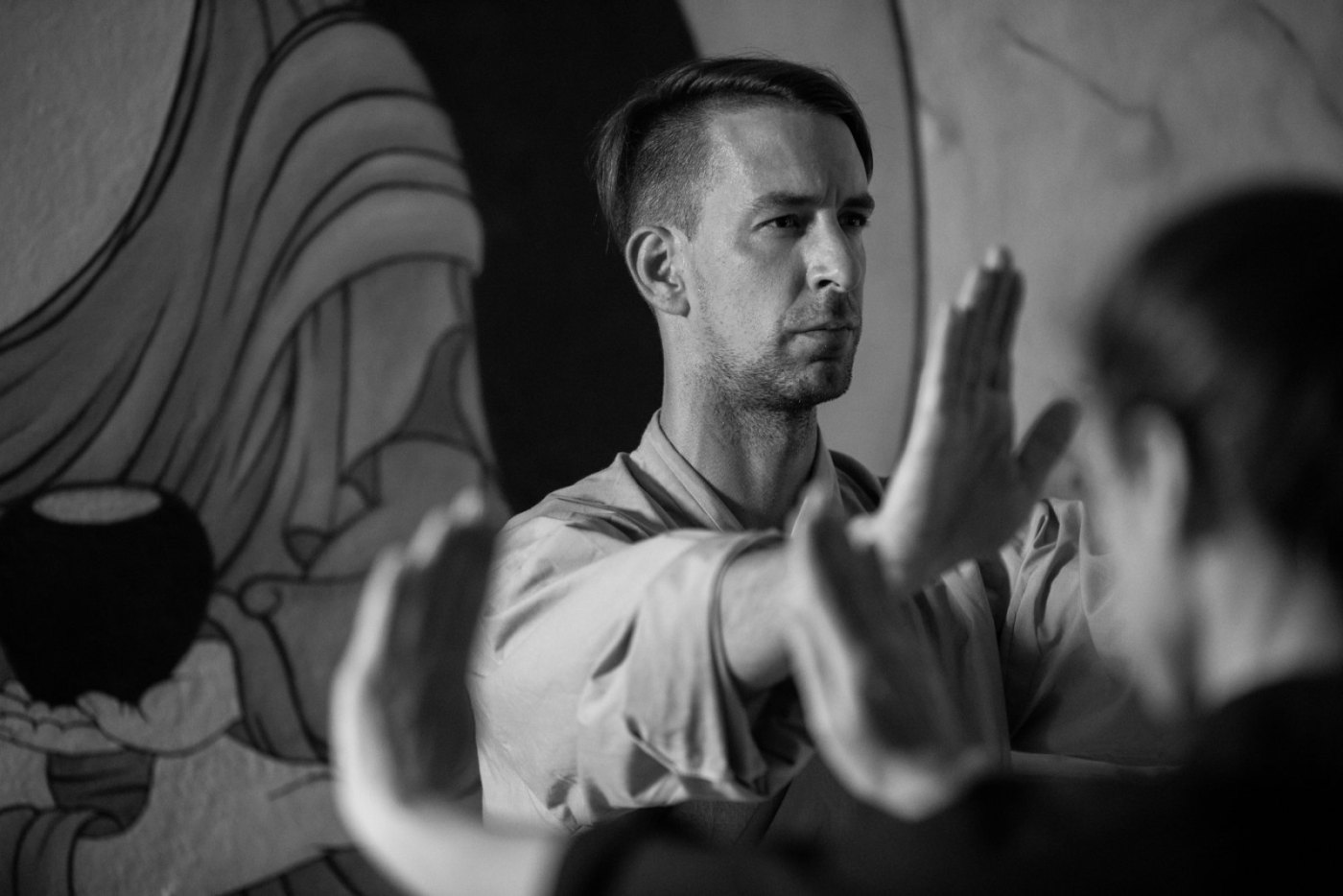
At the start and end of class, before partner work and when meeting the teacher, in Kung Fu we greet each other with fist and palm. This is called baoquan (抱拳), roughly “embracing the fist”. It is a short movement, but there is a lot in it.
How it is done
You stand upright, feet together. The right hand is a fist, the left palm is open and covers the fist. The hands are in front of the chest, at shoulder height or slightly lower. The gaze is directed at the person or space you greet. You may bow slightly.
Interpretations
The salute has several interpretations, which different schools stress differently:
- Power under control. The fist stands for martial skill, the open palm for civility and control. Skill is always subordinate to values.
- Friendly intent. The fist is covered - you come not as an opponent but as a fellow student.
- Unity. Two hands meeting stand for the connection between people who train together.
In the Buddhist setting of Shaolin a salute with one palm in front of the chest is also common, expressing the respect of monks. There are also historical explanations linked to periods of political unrest, but these are less reliable.
Why we use it
- A transition. The salute separates everyday life from training. Once you salute, your head is in the hall too.
- Respect. For the teacher, the partner and the space.
- An agreement. Before partner work it means: I trust you and you can trust me.
Common mistakes
- Swapped hands (left fist, right palm) - in some traditions this has a different meaning.
- A salute in passing, without looking.
The salute is part of every Kung Fu class. We show it to you in your first class.
Frequently asked questions
Which hand is the fist? The right is the fist; the open left palm covers it.
Do I have to bow? A slight bow is usual but not compulsory.
Does the salute have a religious meaning? Not in our training. It is an expression of respect.


