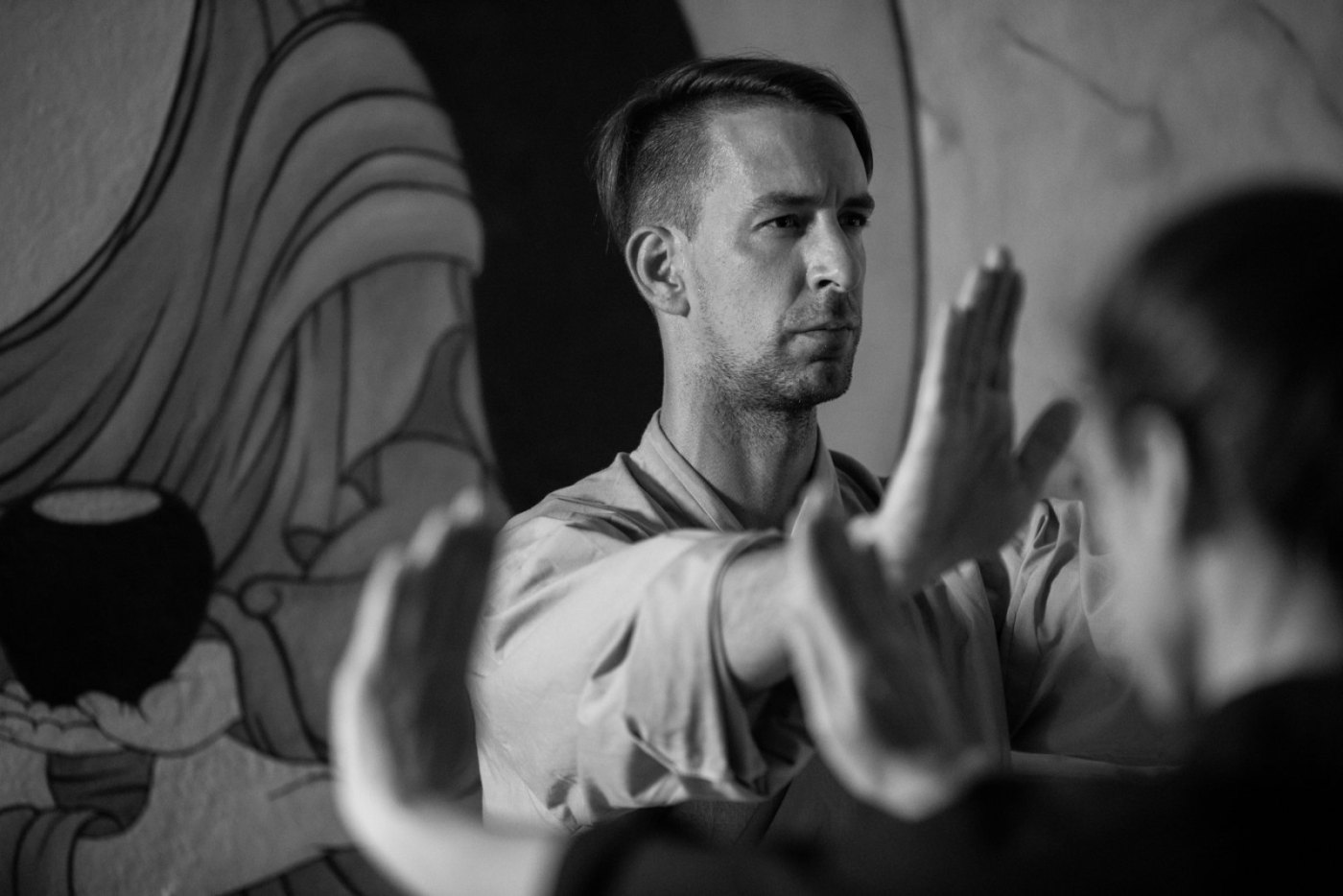
Most people arrive with a clear idea: Kung Fu is for strength and fighting, Qi Gong is for calming down. One for people who want to sweat, the other for people who want to breathe. That line dissolves within the first month of training - not because we set out to break it, but because the body shows very quickly that these are the same thing.
This piece is for anyone choosing between the two. Short answer: usually both. The long answer follows.
What Kung Fu builds
Kung Fu builds structure. The word sounds abstract until you take it apart.
How you stand. Where the weight sits - heel, ball, middle of the foot. How that weight moves from one leg to the other without the torso wobbling. How power travels from the floor through ankle, knee, hips, spine and shoulders to the fist - and where along that chain it leaks away when one link is slack or over-tightened.
That is the frame. Without it a movement is just arm-waving that looks similar but carries nothing. Which is why most of the first year goes into things that do not look like a martial art at all: low stances, weight transfer, one combination repeated until it settles into the body.

What Qi Gong builds
Qi Gong builds what fills that structure: breath, softness and body awareness.
Structure without those turns rigid. And rigid structure does not yield - it snaps. That is not a metaphor: most injuries in martial arts happen because a tense body braces against a force instead of guiding it onward.
Qi Gong fixes this from the other end. Slow, repeating movements matched to the breath show the body how much tension it actually needs, which is almost always less than it is using. After a few months, students notice they produce the same movement with less effort and more effect.
Why one without the other limps
Students who train only Kung Fu tend to hit the same wall. Progress does not stop at strength or fitness - it stops at tension. The shoulders rise, the breath closes, the jaw clenches, and half the power goes into fighting yourself. Qi Gong clears that faster than another hundred repetitions of a form, because it addresses the cause rather than the symptom.
The reverse is just as true. Students who do only Qi Gong feel better - they sleep better, their necks hurt less - but they have no framework in which to test that softness. Softness that only survives in a quiet hall at 17:30 is not really softness. Kung Fu provides the test: demanding, sometimes uncomfortable, and honest. Under pressure it becomes clear very fast which parts of what you have learned are actually yours.
The soft overcomes the hard. The gentle overcomes the rigid.

What actually changes
Train both in parallel and the first year tends to go roughly like this:
- Posture. The shoulders stop hanging forward because the chest opens - first in Qi Gong, where there is time to notice it, then in Kung Fu, where there is not.
- Breath. It stops running away at the first effort. That is the difference between gasping after two minutes of a form and being able to talk after two minutes of a form.
- Recovery. Between sessions and after them. A body that can switch into a settled state repairs faster than one that stays on alert all day.
- Fewer injuries. Not because the training is easier, but because the body yields where it would otherwise resist.
- Precision. The body awareness Qi Gong develops means you understand a correction immediately - not just intellectually, but in the part of the body the correction is about.
How we do it
In the afternoon slot, Qi Gong and Kung Fu run back to back: the first hour (17:30-18:30) is breath and movement, the second (18:30-19:30) is forms and technique. The order is deliberate. A body that has spent an hour breathing and opening up learns faster in the hour that follows - and the technique it receives has somewhere to land.
In the morning slot (Mon, Tue, Thu, 6:00-7:15) the two are woven together within one session, along with Sanshou elements. The body is stiffer at dawn, so we start slower and build.
The beginners’ group (Mon and Wed) follows the same structure at a slower pace with more explanation. Nobody expects you to execute anything correctly in the first month.
Common questions
“Do I really need both? I do not have that much time.” No. If you have one hour twice a week, take whichever pulls you more - one practice done regularly beats both done sporadically. But if you have two hours, spend them on one evening on both practices rather than on two evenings on one.
“I am completely inflexible. Will Qi Gong even work?” That is exactly why it will. Qi Gong is not stretching and does not require any starting flexibility; it requires attention. Flexibility arrives as a by-product.
“I am only interested in self-defence.” Fair enough - and Sanshou is part of the program. But a person who stops breathing under stress will not defend themselves well, however many techniques they know. Breath work is not an add-on to fighting; it is its foundation.
Where to start
If you are wondering which one to choose, the answer is usually both. Not because more is always better, but because they are one thing seen from two sides - one from the outside, one from within.
The simplest way to test that is to come to one afternoon slot and stay for both hours. After two hours you will know more than any article can tell you.


