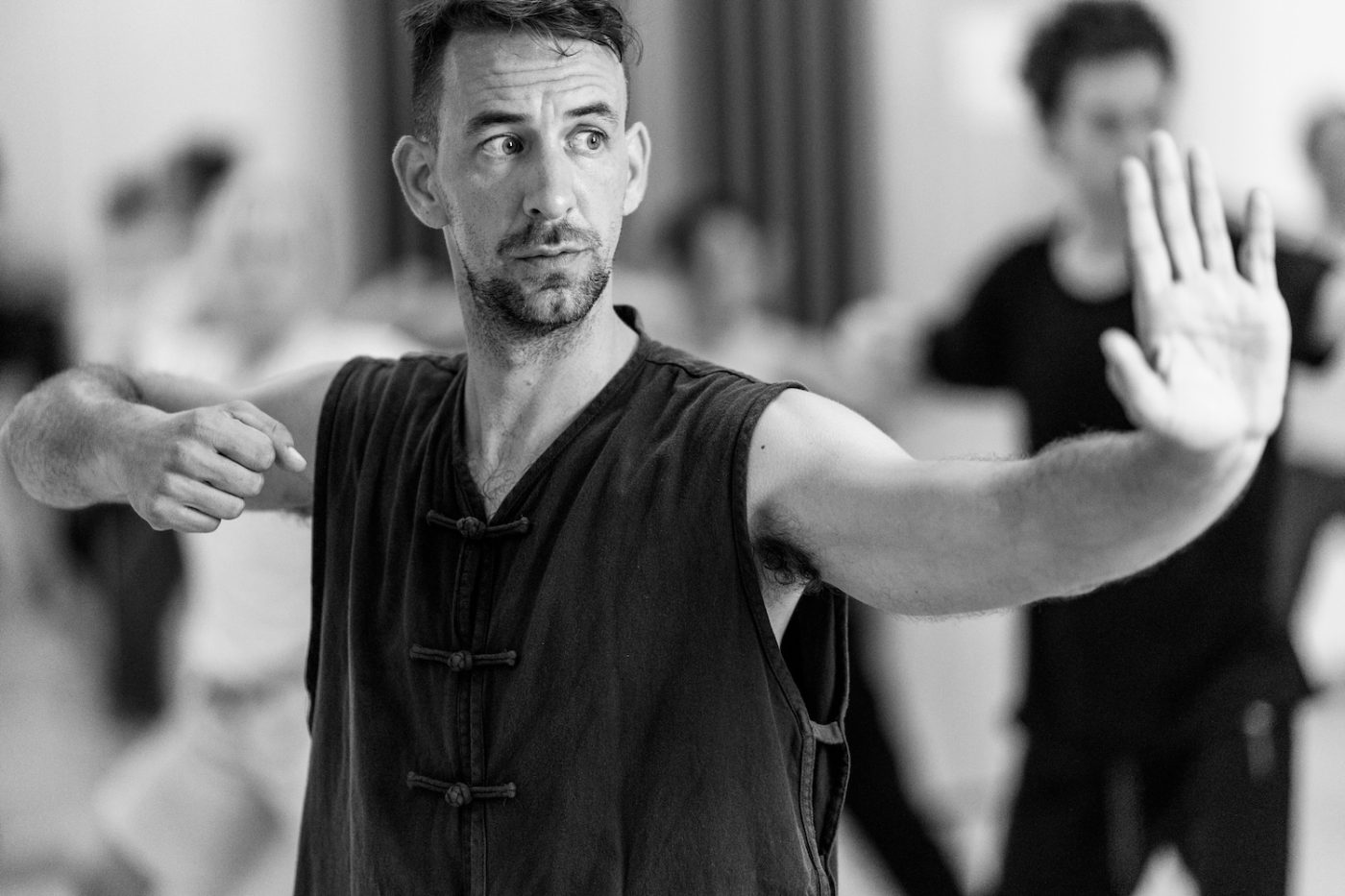
One of the most common criticisms of traditional martial arts goes roughly like this: forms look good, but in a real fight none of what you practise ever happens, so they are a waste of time.
The criticism is right about what it claims - and completely misses what forms are for.
What a form is
A form (Chinese taolu) is a precise sequence of movements practised alone. It lasts anywhere from half a minute to several minutes. It contains stances, transitions, strikes, kicks, turns and breathing patterns strung into a whole you repeat for months and years.
A form is not a simulation of a fight. Anyone who reads it that way will rightly discard it. A form is a vocabulary: a store of stances, weight transfers, angles, distances and ways the body organises itself around an axis.
Nobody expects you to perform a form in a fight. Nobody expects you to recite a dictionary in conversation either - but without words you do not speak. The form is there so you have something to draw from when you have to draw fast.

What a form actually builds
- Structure. Where the weight sits, how the spine lines up, how power travels from the floor. None of this can be learned in a fight, because a fight carries too much information at once.
- Body memory. A movement repeated three thousand times needs no decision. That is the only reason anything works under pressure.
- Leg strength and stamina. Low stances held through a long sequence are considerably harder than they look.
- Breath. A form has a breathing pattern. Lose it and you do not reach the end.
- Focus. A sequence cannot be performed while distracted. That is the meditative part of Kung Fu, even if nobody calls it that.
What Sanshou is
Sanshou (散手, literally “free hand”) is the Chinese fighting system: strikes, kicks, throws and wrestling in free movement - with a partner who disagrees with you and moves however they like.
This is where you find out how much of the vocabulary you can actually use. And the answer is always: less than you thought. That is not a defeat, it is information - and the only way to get it.

Why neither works alone
Forms only. The movements are clean, the stances deep, the execution beautiful - and all of it falls apart the moment someone pushes back. You have never tested distance, timing, or what happens to a movement when someone interferes with it. The result is knowledge that exists only in an empty hall.
Fighting only. You become useful quickly and plateau quickly. Without the vocabulary you repeat the three things you are good at and avoid everything else. It works for two years, then the body sends the bill - usually through a shoulder or a knee.
The soft overcomes the hard. The gentle overcomes the rigid.
How we train it
The move from one to the other is gradual and has clear stages.
- Basics and a short form. A new student starts with stances, weight transfer and a short sequence. A few months.
- Technique with a cooperating partner. The partner does exactly what was agreed. The aim is distance and angle, not outcome.
- Technique with light resistance. The partner starts interfering - slowly, predictably, by agreement. This is where the gap between what you know and what you understand first becomes visible.
- Free movement with constraints. For example hands only, a fixed distance, no full power. The field is narrowed so that something can be taken from it.
- Free sparring. Only when the student is ready - physically and technically - and never as a test of courage.
Nobody jumps from stage one to stage five. And nobody spars because someone challenged them.
What you take away, even if you never fight
Most of our students will never be in a fight and have no wish to be. They still take three things from Sanshou that a form alone cannot give.
Calm under pressure. When someone steps into your space and moves fast, the body does predictable things: the breath closes, vision narrows, muscles clamp. Experience that under controlled conditions often enough and the response settles - and that carries far beyond the hall.
A sense of distance and space. How much room you need, when someone is too close, when it is better to step back. Useful every day, in a crowd and in a conversation.
Awareness of what your body does when it is frightened. Surprisingly useful knowledge that almost nobody has.
Practicalities
Both are part of the regular Kung Fu program - in the morning slot (Mon, Tue, Thu, 6:00-7:15) and the afternoon one (Kung Fu 18:30-19:30). Beginners start with forms and basics; Sanshou arrives when it arrives.
If the fighting side is what interests you most, say so. If it does not interest you at all, say that too - the program can be steered either way.


