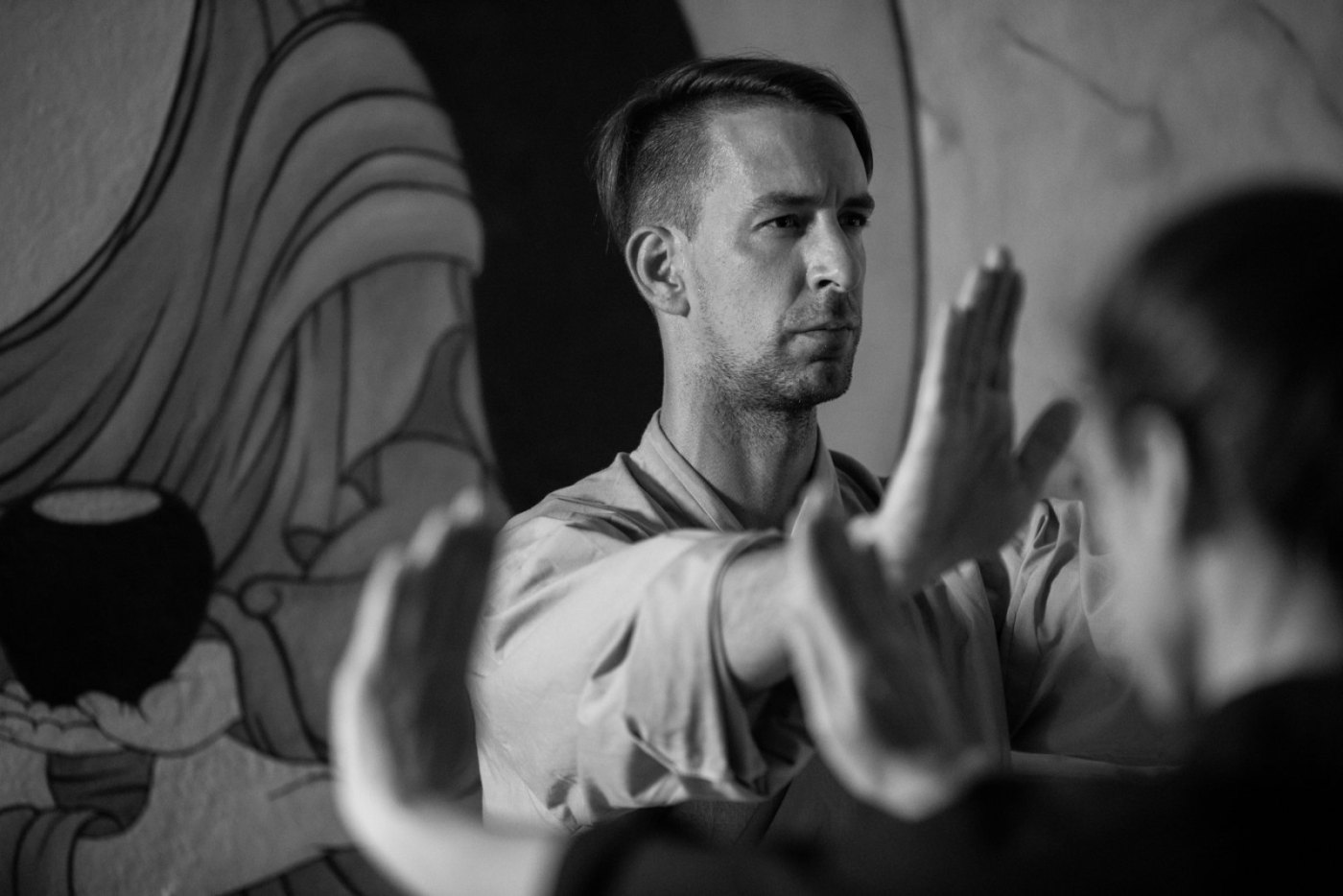
A great deal gets written about children’s concentration in martial arts. Almost nothing about adults, because an adult is assumed to have concentration already.
They do not. An adult who works at a computer has ten or twenty years of training in the opposite direction behind them - in interrupting, switching, holding three threads at once. That is a skill, but it is a skill that displaces another one.
Why a form is unusually good attention practice
A form is a sequence of sixty or a hundred movements performed without a break. Three things happen during it that are hard to find together in an adult day.
The task has a sharply defined end. The form ends when it ends. You cannot do seventy per cent of it and move the rest to tomorrow. That alone separates it from almost everything an adult does during the day.
Error is immediate and unambiguous. If your mind goes to your inbox between the tenth and eleventh movement, you stop. You do not do it worse - you stop, because the movement does not arrive. That is feedback office work almost never gives, where the consequences of distraction surface in three days or never.
Switching is impossible. During a form you cannot simultaneously think about something else, because it shows instantly. An hour of form is therefore one of the few hours in a week spent in a single place.

What actually happens in the head
In the first weeks, memory happens. The sequence is not yet in the body, so the head pulls it out step by step, and that is tiring in a way that surprises people. Many notice after a first form that they are more tired than after the warm-up.
After a few months it shifts. The sequence is in the body and the head is no longer needed for what comes next. That is when the interesting part appears: space opens up, and the head immediately tries to fill it. That is precisely where real attention training begins - the form runs, thought tries to wander, and each time you return.
After a year or two comes a third stage students find hardest to describe. The form runs, the head is quiet, and it is not effort but the absence of effort. It is not frequent and it is not on demand - but when it happens, it is why people train for decades.
What carries over into work
Care is needed here, because this is where too much gets promised. Kung Fu will not turn you into someone who reads contracts without drifting.
What is actually observable in students is narrower and still useful.
Noticing the moment you drift. That is a trained skill - in a form you repeat it fifty times an hour. At a desk it shows up as noticing you have been on your phone for three minutes rather than realising it half an hour later.
Tolerance for boredom. Repeating one stance a hundred and fifty times is boring. Once that becomes acceptable, so does an hour of uninterrupted work on a single task.
Less need to interrupt. The urge to check something after every completed item slowly reduces under training that does not permit interruption.

Why this works better than meditation for adults
It does not work better - it works more easily. Sitting meditation asks you to sustain attention with no external support, which is very hard for a beginner. A form provides the support: the body moves, the movements follow one another, and attention has somewhere to sit.
For many people who tried meditation and gave up, a form is the first place where concentration appears as something that can be practised at all. Sitting comes later, and by then it works.


