
The question comes up in almost every first phone call, and almost always apologetically: “I’m not exactly young any more - does this still make sense at my age?” A number follows, usually somewhere between thirty-five and fifty-five.
The answer is yes, and not out of politeness. The large majority of people in our hall started Kung Fu after thirty. Those who trained from childhood are the rare exception, not the rule. What is interesting is something else: an adult beginner learns some things faster than a child and other things slower - and it is worth knowing which are which.
What comes faster for an adult
An adult understands why. When the teacher says the weight must stay in the middle of the foot, a child does it because they were told. An adult asks why, gets an answer about how force travels through the ankle and knee - and from that moment corrects it themselves, including when nobody is watching. That is an enormous advantage. Progress in a martial art does not happen in the hall; it happens in the repetitions you do correctly without being corrected.
An adult also knows why they came. A child is brought by a parent, a teenager arrives with a friend. An adult decided alone, usually after months of thinking about it, and that decision holds on the evenings when it is raining and staying home would be easier.
Third: an adult can tolerate boredom. The first year of Kung Fu is largely repetition. The same stance, the same combination, the same weight shift. A child gets lost in that and needs play; an adult understands that the repetition is the content, not the route to it.

What comes slower
This deserves saying too. Mobility returns more slowly in an adult - less because of age than because of years of sitting. Hips held at ninety degrees for two decades do not open in a month. They open over a year, and they open completely.
Learning longer forms is slower as well. A child absorbs them because they do not analyse them. An adult takes them apart, which is good for understanding and bad for pace. We handle that by not giving forms too early - individual movements and stances come first, and the form arrives once there is something to build it from.
And recovery, of course. At forty-five the body needs a day more after a hard session than it did at twenty. That is why the adult groups never go flat out three days running, and why Qi Gong sits right next to Kung Fu in the timetable - not as an extra, but as part of the system.
The injuries you bring with you
Almost every adult beginner arrives carrying something: an old knee injury, a sensitive lower back, a shoulder that no longer goes all the way up. None of that stops you enrolling, but it is something to mention in the first class.
We adapt the training. A low stance has four different depths, a kick has three heights, and none of those options is “the easy version for people who can’t” - they are simply different loads on the same thing. Nobody in the group notices that someone is working at a different depth, because everyone is working at the one that suits them that day.
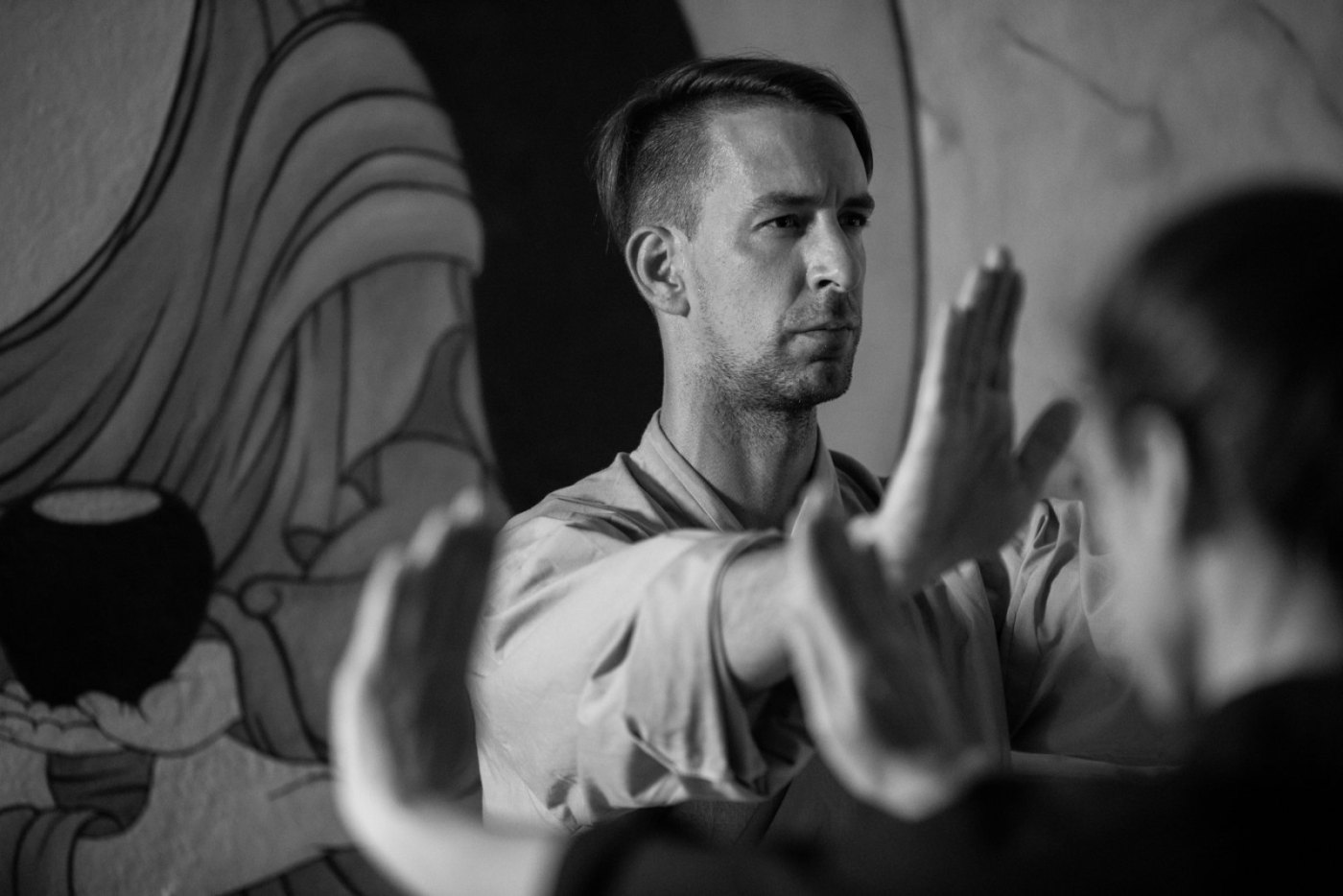
What the first month looks like
The first week hurts. Not injury - muscles you did not know existed: inner thighs, glutes, the front of the shoulders. It lasts three or four days and never returns at that intensity.
In the second week comes the feeling that you are learning nothing. That is normal and it is actually a good sign: the body is busy with balance and weight transfer, which does not show from the outside.
In the third or fourth week something clicks. Usually it is the moment you make a stance without assembling it in your head first. From there it is long, slow, very satisfying work.
When it really is too late
For Kung Fu as we practise it, essentially never. We have people training well past sixty. What changes with age is not whether but what: fewer jumps, less sparring, more forms, more Qi Gong, more balance work - which at seventy is considerably more useful than a high kick.
The only genuine “too late” is the one you build yourself, by spending so long deciding whether it makes sense to start that a year goes by. You could have spent that year training.


