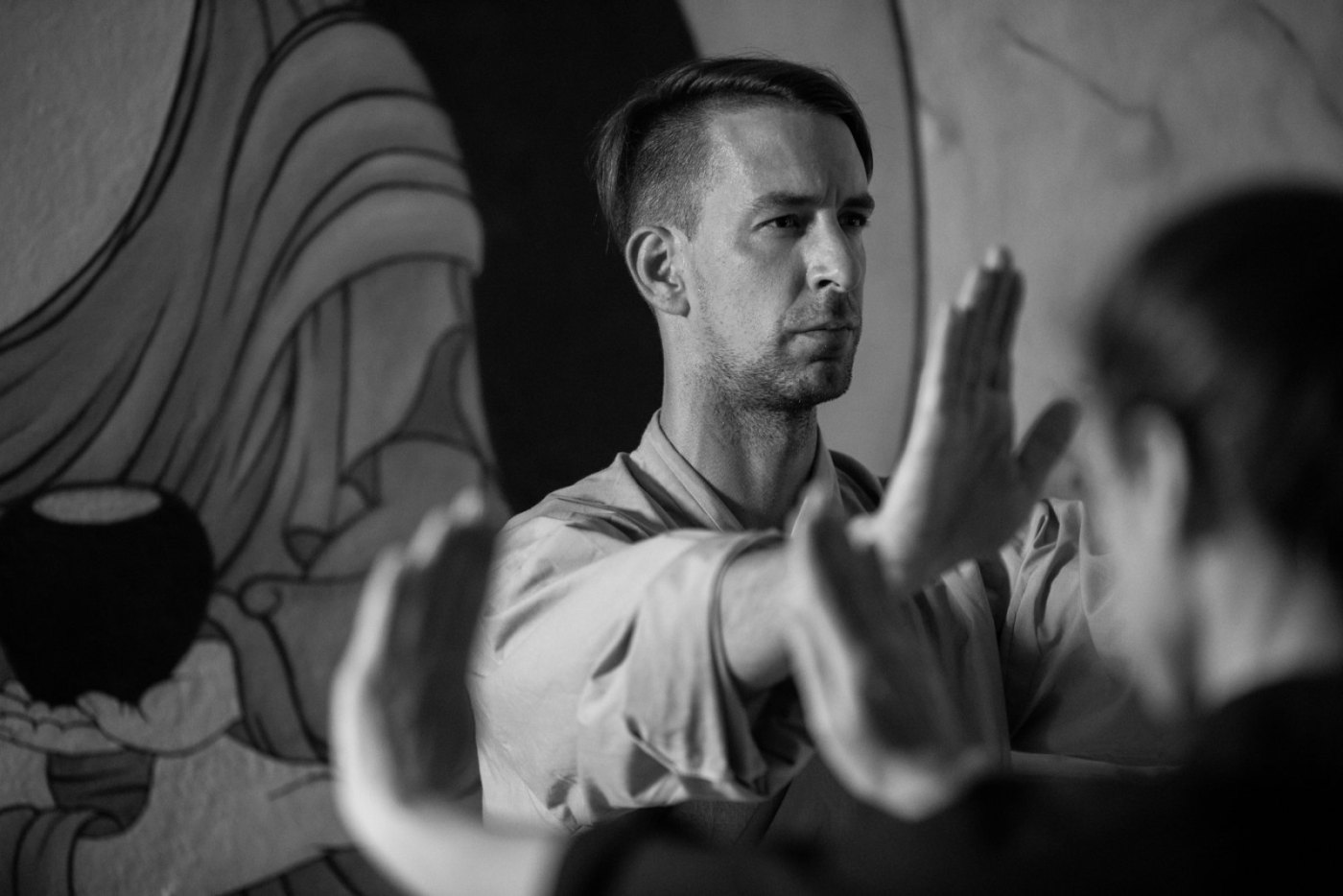
“Relax” is the most frequent instruction in our hall and the most frequently misread. A student hears the word and does one of two things: either lets go everywhere and falls out of the stance, or nods and changes nothing, because they do not know what to relax.
This piece is an attempt to make that instruction usable.
What relaxation is not
It is not limpness. A limp body cannot hold a stance and cannot take force. If following the instruction costs you your structure, you went too far.
It is not calm in the head. You can be perfectly calm and have shoulders like stone.
It is not the absence of effort. A low stance is hard work even when relaxed. Effort and tension are not the same thing.

What relaxation is
Relaxed means: you use only the muscles the task requires, and only as much of them as it requires.
Everything else is surplus work. Surplus work costs energy, slows the movement, and blocks the path force should travel along.
An example: in a low stance the thighs and glutes must work. If you also clench the jaw, shoulders and hands, you have added three muscle groups that are not holding the stance - only spending.
Where tension hides
Almost always in the same four places. Check them in order, including right now while reading.
- The jaw. First on the list and most often overlooked. A clenched jaw tightens the neck, the neck tightens the shoulders, and the shoulders stop the breath.
- The shoulders. They rise towards the ears at every effort. It is a reflex and it does not resolve itself - it needs watching.
- The hands. A clenched fist during a movement that does not need one is the most reliable sign of a student trying hard.
- The breath. Not a muscle, but the best indicator of all. If the breath stops, there is tension somewhere, even if you cannot feel it.
The soft overcomes the hard. The gentle overcomes the rigid.

Why it matters in a martial art
Speed. A tense muscle cannot contract quickly, because it is already contracted. The fastest strikes come out of a relaxed arm.
Power. Force travels from the ground through the body. Every tense link in the chain absorbs part of it instead of passing it on.
Endurance. Tension is work without a result. It is why people are so tired after their first few sessions - not from the training, but from the surplus.
Safety. A tense body braces against an impact or a fall. A relaxed body yields and passes the force onward. Most martial arts injuries are the consequence of tension rather than force.
How it is trained
Slowly. In a fast movement you cannot see where you are tense. In a slow one you see it immediately.
With the breath. An exhale is the fastest way to release tension. When a teacher points at your shoulders, breathe out - most of the time they drop on their own.
By running through a checklist. During every long stance, go through the four points: jaw, shoulders, hands, breath. It takes three seconds and it works.
In Qi Gong. This is the entire content of that practice. Which is why relaxation is learned faster there than in Kung Fu, and then carried across.
How you will know you have understood
When you are less tired after an hour than you used to be at the same load. That is the only reliable indicator - and it usually arrives somewhere in the third or fourth month.
Until then a simple rule applies: when you hear “relax”, do not let go everywhere. Check the jaw, the shoulders and the hands, and breathe out.


