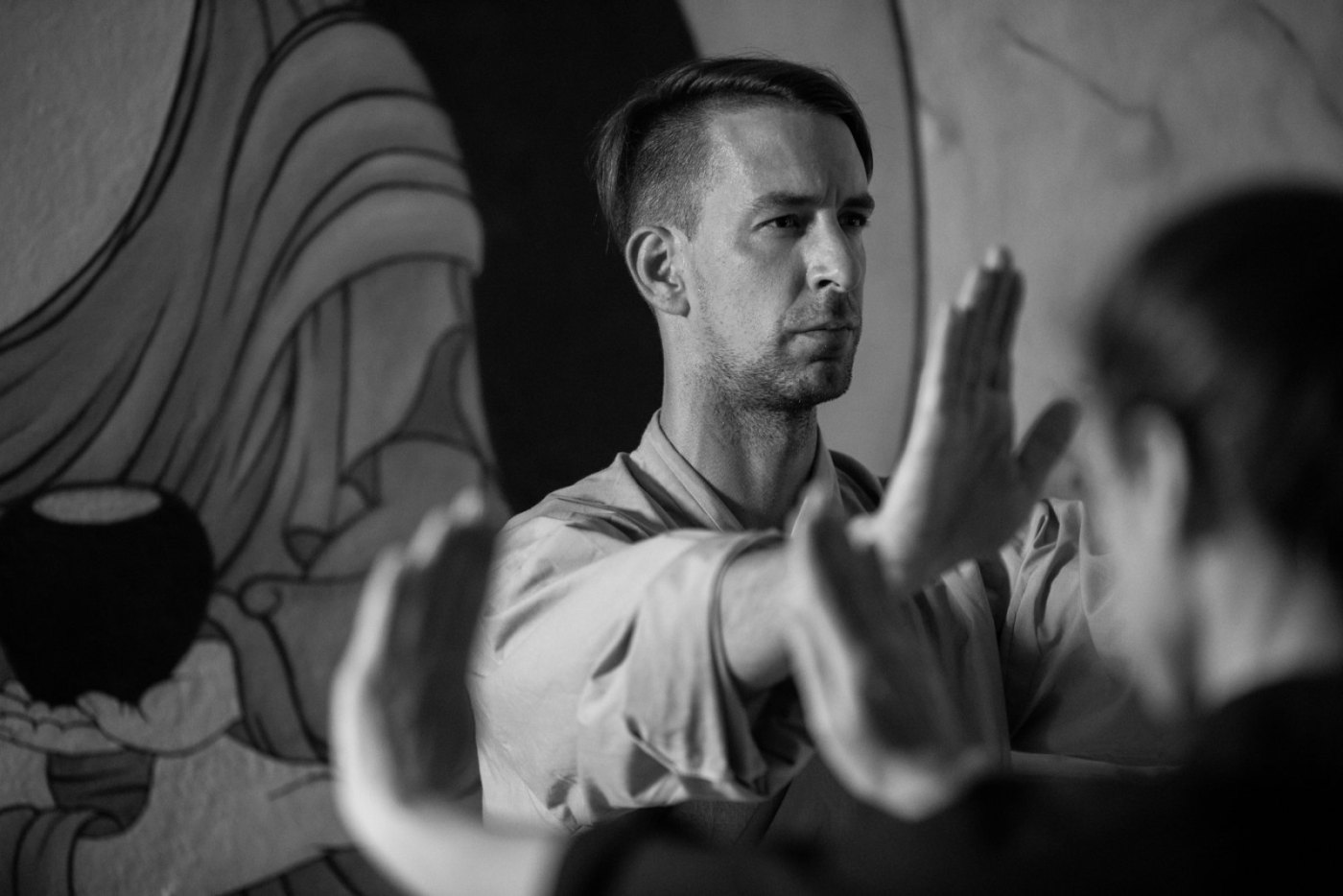
“I am too old for this.” It is the most common reason we hear - and it almost always comes from people who are in excellent shape to begin.
This piece is for them: for those who trained something once and stopped, and for those who never did, whose back now hurts and who know something has to change.
Why starting late is not a disadvantage
A twenty-year-old trains with strength and gets away with it. They have a reserve that forgives poor technique - which is exactly why they never learn it. A forty-year-old has no such reserve and is therefore forced to work precisely. And precision is what lasts.
Almost without exception, our most precise students did not start young. That is not a coincidence and it is not a consolation prize.
You also arrive with something a twenty-year-old does not have: the ability to keep going once it stops being new. Kung Fu is a skill where almost everything that matters happens after it stops being interesting. People who have already carried something in life through to the end have a large advantage here.

What a body over forty needs
- Load, not rest. Joints, tendons and bones strengthen through use. Rest does not fix stiffness - movement does. The most damaged bodies we see are not overtrained but under-used.
- Hip mobility. Desk work shortens the hip flexors and shifts the work onto the lower back. Low Kung Fu stances do exactly the opposite, and for many people they are the first thing in years that eases the back.
- Balance. A capacity that measurably declines after forty - and measurably improves with practice. Standing on one leg is not acrobatics; it is everyday survival.
- Gradual progression. Not easier training, but longer warm-ups, more room to recover and fewer jumps in load.
- Breath work. Recovery is slower after forty. A body that can switch from tension into recovery can afford more training.
How we adapt
The classes are group classes; the corrections are individual. That is the most important sentence in this piece.
If your knee is damaged, you get a higher stance and a different angle. If your shoulder hurts, you do the same technique without the overhead finish. If a tendon is tight, you skip the jumps and work the transition. Nobody will push you into a movement your body cannot take today, and nobody will make an issue of it.
What we need from you is that you say so. A teacher sees a great deal, but not where you were operated on three years ago.

If Kung Fu is too much
For anyone who needs more adaptation still, Qi Gong is the best way in: low joint load, high return on posture, breath and mobility. Many people start there, add Kung Fu a few months later, and a year on are doing both.
This is not “the easier version”. It is a different route to the same thing, and for certain bodies simply a better one.
A journey of a thousand miles begins beneath one’s feet.
What to expect in the first year
The first three weeks: muscle soreness, mainly thighs and glutes. The feeling that you have forgotten how a body moves.
After two months: noticeably better posture. The first comment usually comes from someone else, not from you.
After six months: movements that were impossible at the start. Deeper stances, better balance, breath that holds through a form.
After a year: mostly this - your back no longer makes mornings harder. And you have stopped wondering whether you are too old.
Common worries
“I have no fitness.” Fitness is not an entry requirement but a consequence of training. In the first month you will stand more than you work, and that is fine.
“I will be the oldest in the group.” Almost certainly not. Our afternoon groups span from twenty to seventy and it bothers nobody.
“What if I cannot do it?” You will not be able to do it. Nobody can in the first month. The question is not whether you can, but whether you come back next time.
Where to start
The afternoon beginners’ group (Mon and Wed, Qi Gong 17:30 and Kung Fu 18:30) is built for exactly this kind of start. You can come to one hour or to both.
Come, tell us where it hurts, and let us start from there.


