
When someone comes to us because of self-defence, we do not start with techniques. We start with three things that are not techniques and that solve considerably more situations than any grip.
1. Distance
Everything is decided here. If someone cannot reach you, they cannot do anything - and conversely, once they are too close, your options narrow drastically.
What we train: the sense of when someone has entered the space from which they can reach you. That is not taught by explanation but by experience - in a drill where a partner approaches and you notice the point at which it becomes uncomfortable.
After a few months you notice it earlier. Not in the hall - at a bus stop, in a crowd, in a conversation with someone standing too close.
A practical rule: if you cannot take a step backwards, you are too far in. That holds in situations with nothing to do with danger, too.
2. Voice and posture
Most situations are decided before anything physical happens. They are decided by how you stand and what you say.
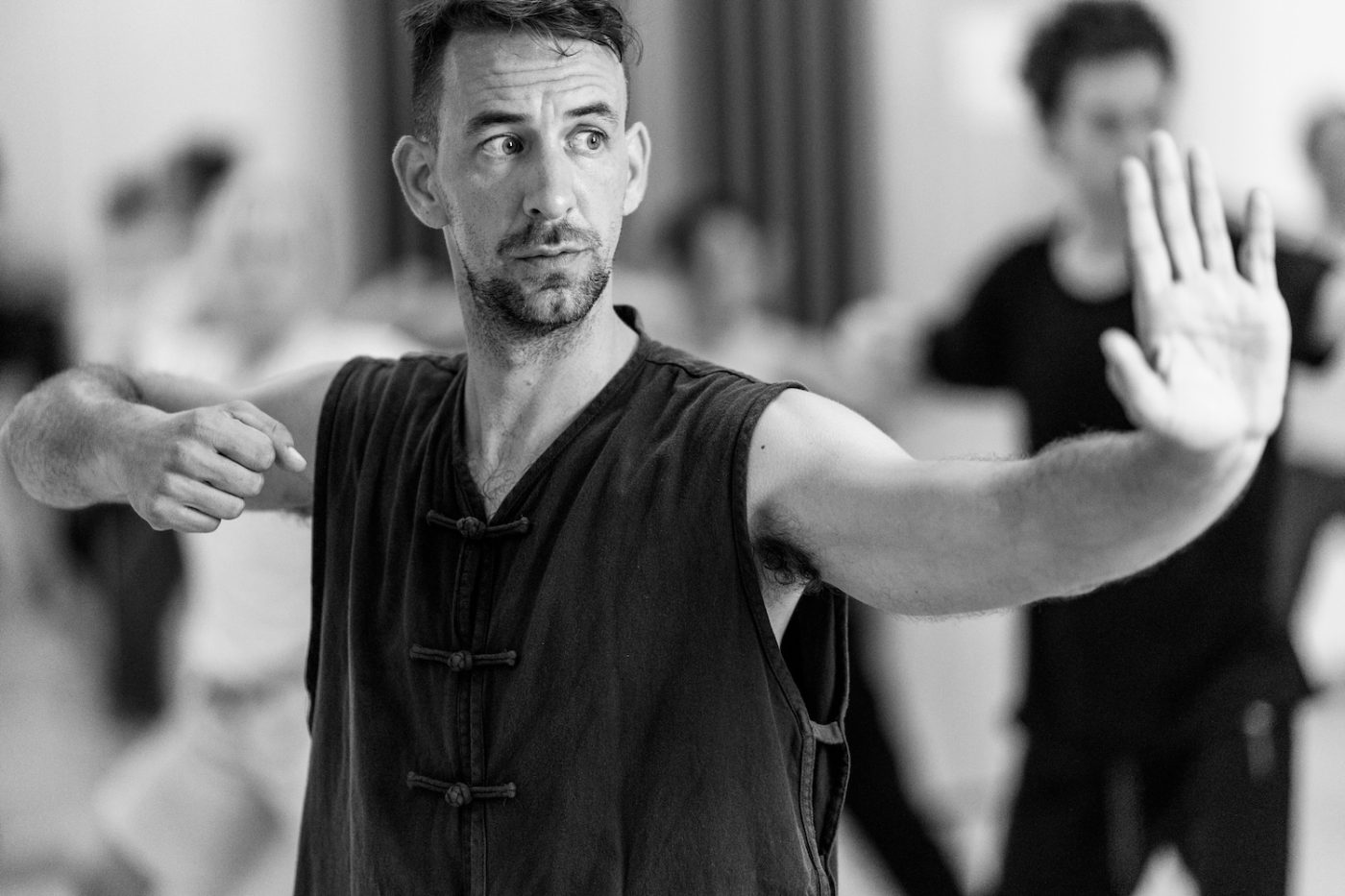
Posture: feet hip-width apart, one foot slightly back, weight centred, hands in front of the body with open palms. This is not a fighting guard - it is a position you can take on a street without escalating anything, and from which you can move in any direction.
Open palms matter for two reasons: they say you are not seeking a fight, and they are far easier to defend legally than a raised fist.
Voice: loud, short, clear. “Stop.” “Back.” “No.” Not explaining, not negotiating.
The voice does three things at once: it sets a boundary, it draws the attention of passers-by, and - most underrated - it triggers your own exhale. Anyone shouting is breathing; anyone breathing has not frozen.
This has to be practised out loud. People who have never done it in a hall cannot do it in a real situation. It is awkward for everyone the first time.
3. Withdrawal
The most successful self-defence technique is leaving. There is no exception and no better alternative.
What we train: moving off the line - a step to the side rather than backwards - and creating the distance that makes leaving possible. Not turning and running with your back exposed, but a movement that keeps your field of view.
We also train something harder: the decision to leave when someone is provoking you verbally. For many people that is the hardest part of the whole practice, because what blocks it is pride, not technique.
The soft overcomes the hard. The gentle overcomes the rigid.

Why these three
Because they work at a high heart rate. When fine motor control goes, what remains are gross movements, the voice, and decisions made in advance.
A technique requiring a precise grip on a wrist fails under stress. A step to the side and a loud “no” do not.
What comes after
Only once those three work does it make sense to add physical techniques - escaping a grip, creating distance with the arms, breaking the line. There are few of them and we train them for a long time, because each has to live in the body rather than the head.
All of it is built into the regular Kung Fu program at Ziherlova 44 in Ljubljana. Distance and posture are part of every hour from day one - even when we never mention self-defence.


