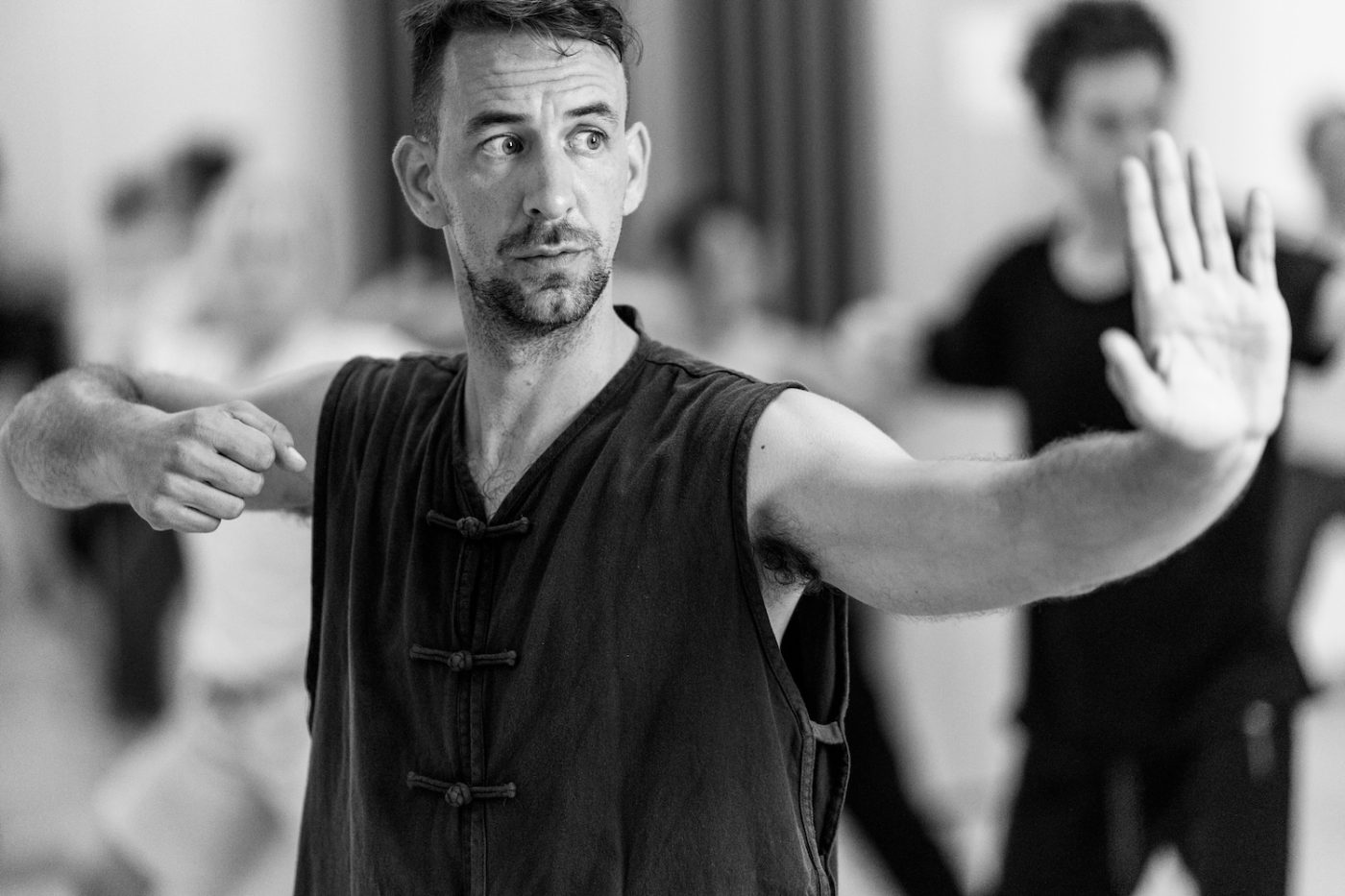
When people think of the Chinese martial arts they often picture kicks above head height. When they come to a class, they are surprised that most of the kicks we train are below the waist. That is not a lowering of standards - it is a choice with both tradition and some sober arithmetic behind it.
What happens when you kick high
Every kick is a trade. You lift a leg, so for that moment you stand on one. The higher you go, the more of three things happens:
- It takes longer. The path from the floor to a head is longer than the path to a knee, and that gives the other person time.
- You are more open. With the leg up, the pelvis is turned and the centre of the body is uncovered.
- Balance is fragile. If the kick misses or is caught, you are on one leg with a high centre of gravity. That is the worst position available.
In a hall, warmed up, with plenty of room and a cooperative partner, a high kick works beautifully. On a wet pavement, in a coat, with no warm-up, it is another story.
A technique is only as useful as it is in the worst conditions, not the best.

What the tradition says
An old Chinese saying holds that kicks above the waist are dangerous chiefly to the person throwing them. In the southern Chinese schools kicks are almost exclusively low; in the northern ones - the lineage Shaolin belongs to - higher kicks do appear, but mostly within forms and as mobility training, not as a primary fighting tool.
High kicks as the centre of a fighting method are a relatively recent phenomenon, closely tied to competitive sport and to film. Both have their own rules: in a contest a kick to the head scores more, and on screen it looks better.
So what do we train
Kicks to the knee, the shin and the thigh. Pushing kicks to the pelvis that create distance. Low round kicks to the outside of the thigh. What they share is that the centre of gravity stays low and the standing leg stays firm, and that you can throw them in everyday clothes.
For self-defence the knee is the most sensible target: it is closer to you than a head, it cannot move away as quickly, and the effect is immediate.

Why we still practise high kicks
Because they are excellent training. Leg raises in the warm-up and high kicks within forms build hip mobility, abdominal strength and balance - all of which improve the low kicks too. The difference is one of purpose: we kick high to build the body, and we kick low because that is what we would use.
If you want to see how that works in practice, the easiest way is to sign up for a class. We train at Ziherlova 44 in Ljubljana.


