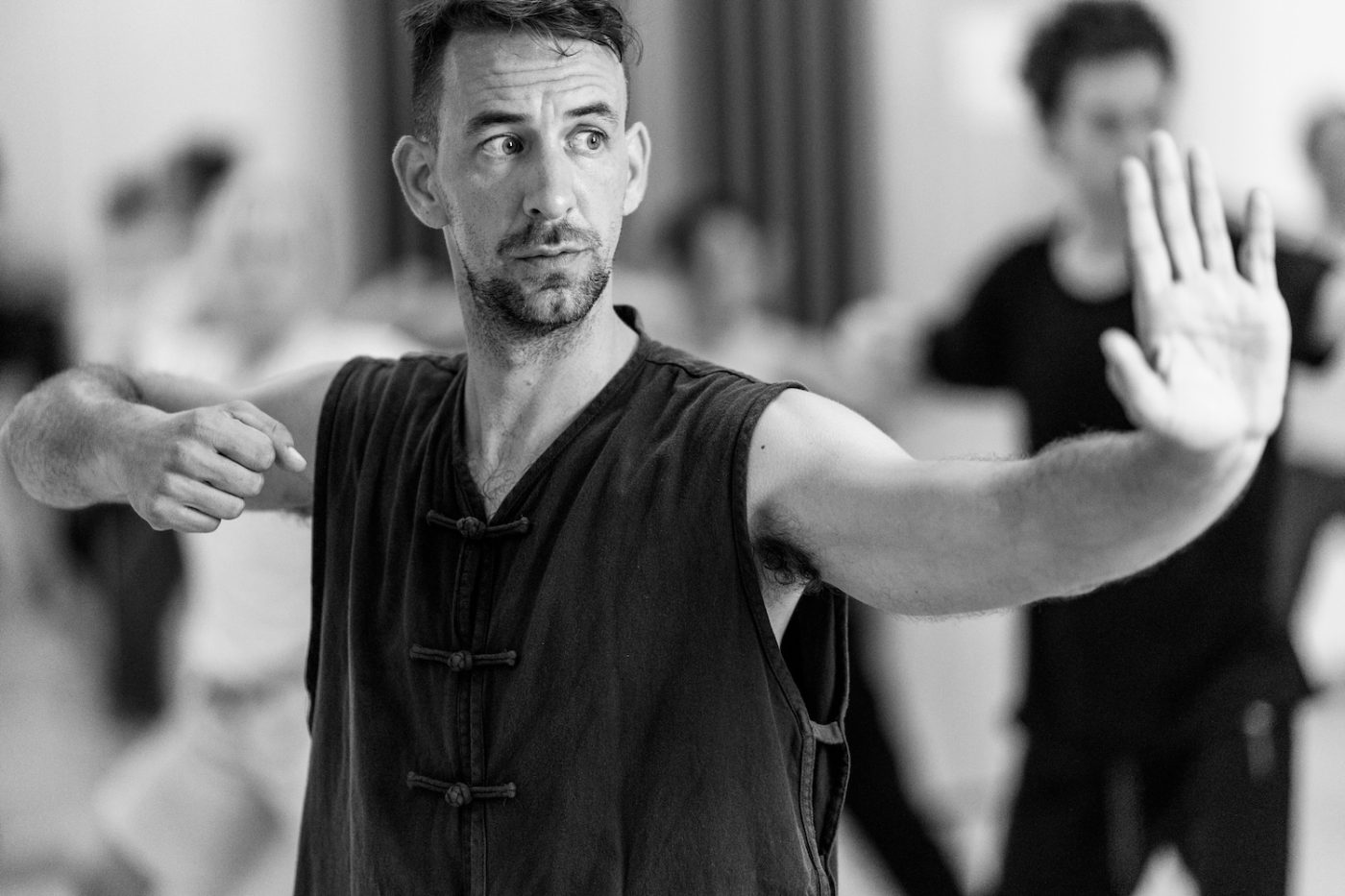
The word Sanshou produces two opposite reactions in new students: some cannot wait, others hope they will not have to.
Both have the wrong picture, because both imagine the final stage - two people in free movement. That is a long way off, and most of the training happens well before it.
What Sanshou is
Sanshou (散手, “free hand”) is the Chinese fighting system: strikes, kicks, throws and wrestling. In a traditional school it is not a separate discipline but a test of what you have gathered in forms and basics.
The aim is not to beat your partner. The aim is information: what holds up when circumstances stop cooperating.

The five stages of entry
- Technique with a cooperating partner. The partner does exactly what was agreed, at a speed you set. You work on distance and angle, not on outcome. You stay here for months.
- Technique with light resistance. The partner starts interfering - slowly, predictably, by agreement. The gap between what you know and what you understand shows up for the first time.
- Constrained free movement. Hands only, or a fixed distance, or no strikes to the head. The field is narrowed so something can be taken from it.
- Free movement with controlled power. All techniques allowed, power capped at an agreed level.
- Free sparring. Only for those who want it, and never as a test of courage.
Nobody skips a stage. Nobody spars because somebody challenged them, and nobody loses anything by staying at stage one or two forever.
Protective gear
The first two stages need none. From stage three onwards we use:
- A mouthguard. Compulsory the moment strikes towards the head are possible at all. It costs little and saves a lot.
- Gloves. Not for your protection but for your partner’s - and for your wrist.
- A groin guard. Compulsory for men from stage three.
- Shin guards when working with kicks.
Students generally buy their own gear once they reach that stage. You do not need it in your first year.

Rules that always apply
- An agreement before starting. What we are doing, at what power, what is excluded. Always, including among the experienced.
- The word “stop” ends everything, immediately. No explanation, no questions. Anyone can say it.
- Controlled power. Power rises by agreement, never on the fly and never unilaterally.
- Nothing to the spine, neck, knees or groin. Ever, at any stage.
- The smaller partner sets the pace. When two partners differ in size, the lighter one decides.
- Fatigue ends the drill. Most injuries happen in the last five minutes.
The soft overcomes the hard. The gentle overcomes the rigid.
What we do so nobody gets hurt
The teacher assigns pairs. You do not choose. That removes most problems before they arise.
A new student gets an experienced partner. Two beginners together is the riskiest combination, because neither knows how to settle the pace.
Short intervals. Ninety seconds of work, then a break. Longer intervals bring fatigue and worse decisions.
Stop before the peak. We end a drill while it is still going well, not once it has started going wrong.
When you can say no
Always. Today, this week, or forever.
A good number of our students never take up Sanshou and train forms, technique and Qi Gong instead. That is a fully legitimate route through Kung Fu, and none of them is regarded as someone who is not really training.
Practicalities
Sanshou is part of the regular Kung Fu program - in the morning slot (Mon, Tue, Thu, 6:00-7:15) and the afternoon one (Kung Fu 18:30-19:30) at Ziherlova 44 in Ljubljana.
If the fighting side interests you especially, say so - the route through the stages can be quicker. If it does not interest you at all, say that too.


