
At the Shaolin monastery there is a formula that condenses its whole distinctiveness into four characters: chan wu he yi (禪武合一) - “Chan and the martial art are fused into one”. At first hearing it sounds like a line from a brochure. In truth it is the shortest possible description of a method the monks developed over fifteen centuries - and the reason our school in Ljubljana teaches meditation and Kung Fu as one thing, not two.
Why the fusion happened at all
Historically, the fusion was almost inevitable. The monastery was a community of meditators that had to look after its own safety and after bodies weakened by long sitting. Martial training and meditation shared the same rooms, the same daily schedule and the same people. The question was never whether they would connect - only how.
The answer that took shape: both practices train the same thing. Meditation trains the mind at rest; the art trains the mind in motion. The object of training - attention, presence, non-reactivity to disturbance - is identical.

What the formula means in practice
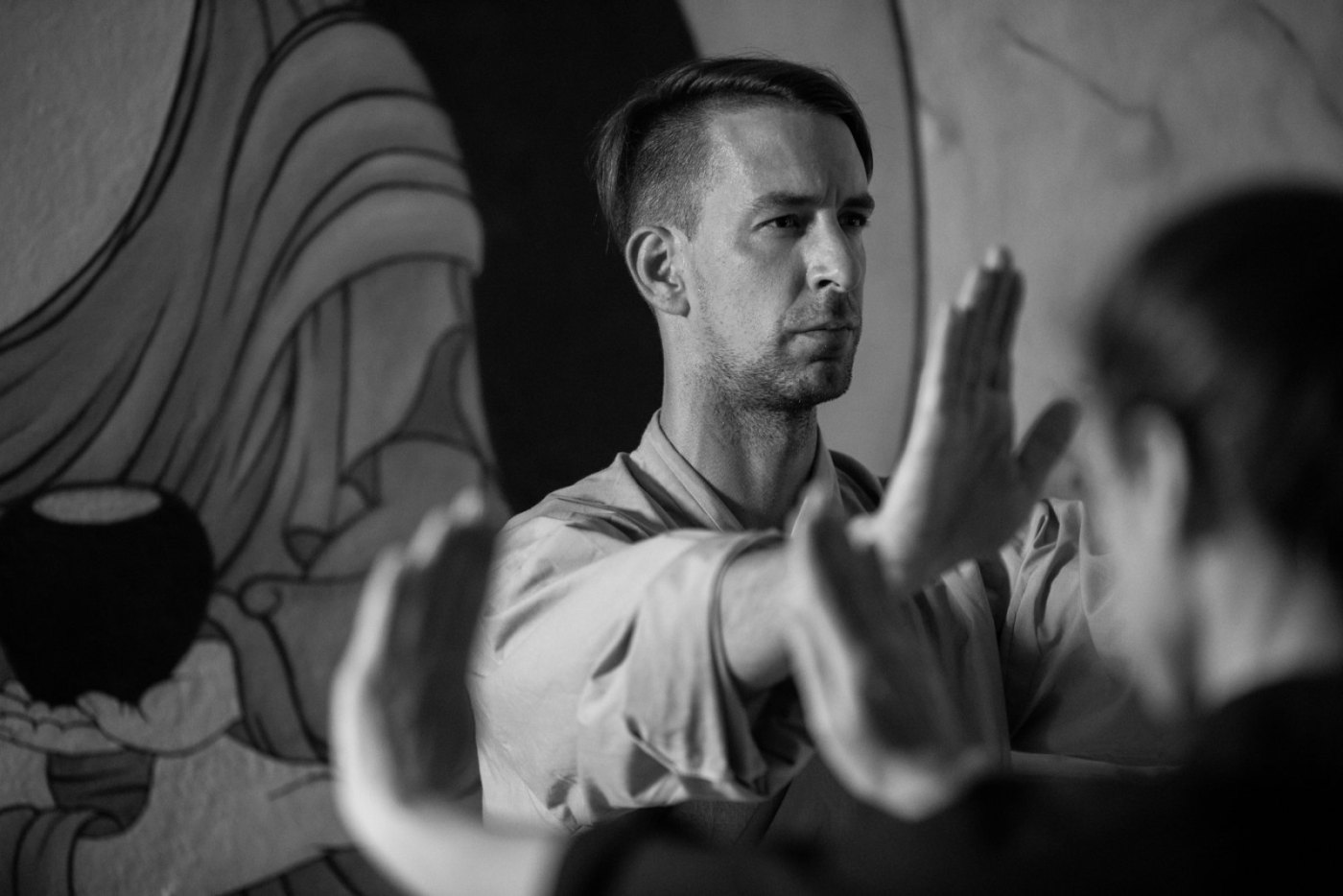
The monastic tradition describes it with two terms: seated Chan (zuochan) and moving Chan (dongchan). Sitting on the cushion is Chan; a form performed with a collected mind is equally Chan; sweeping the courtyard with full presence is too. The measure is not the activity but the quality of mind within it.
In stillness be like a mountain, in motion like a river - both must be trained, because life demands both.
Hence the practical rules familiar to anyone who has trained in this tradition: class begins and ends in silence, the bow marks the crossing into attention, full presence on one repetition beats twenty scattered ones. These are not courtesies - they are meditation tools built into a martial class.
What the fighter gains from Chan
Direct, verifiable things. A mind that does not crash into its emotions: fear and anger arise but do not seize the controls. A gaze that stays wide when space narrows. The ability not to lose the next two seconds to self-criticism after a mistake. In a martial context, attention is literally safety equipment.
What the meditator gains from the art
Less obvious, equally important. A body that can sit without pain. A testing ground: on the cushion it is easy to seem calm - a partner who means it shows you how much calm you actually have. The art grounds meditation; without it, meditation tends to drift into pleasant daydreaming.
What this looks like at Ziherlova 44
Our class is built on this logic, though we rarely announce it. The opening silence and bow are not folklore but a crossing into another quality of attention. The Qi Gong section is meditation in motion. Basics and forms demand full presence - a distracted repetition counts, but teaches nothing. The fighting section tests attention under pressure. And the sitting at the end is not an add-on but the distillate of everything before it: the same attention the body has just trained in movement, now held without movement.
Chan wu he yi, then, is not esoterica. It is a plain observation confirmed across fifteen centuries: mind and body learn fastest together - and what joins them is attention.


