
The case for training at home is strong and hard to argue with. It is cheaper. You lose no time travelling. You train when it suits you. There is unlimited video online and much of it is good.
And yet the large majority of people who start at home stop within two or three months. This is not a question of discipline - the people who stop are the same people who last for years in a group. The difference lies in three things a screen cannot provide.
One: feedback
At home you do not know what you are doing wrong. That sounds obvious, but the consequence is less so: you do not correct mistakes, you consolidate them.
Every repetition of a faulty movement is a repetition that teaches the body something. If your knee rolls slightly inward in a stance and you do not know it, you are not standing still - you are going backwards each week. After six months you have a habit that is harder to remove than learning correctly would have been.
Video does not solve this. The instructor on the recording cannot see you. A mirror helps with some things and misleads with others, because you are watching rather than feeling.

Two: the absence of deciding
This is the largest factor and the one least often mentioned.
At home you have to decide again every day that you will train. The decision is small, but it is once a day, and each time it can go the wrong way - I’m tired today, it’s late today, I’ll do it tomorrow. Willpower is finite and by evening it has been spent on other things.
In a group you do not decide. Tuesday at 17.30 is Tuesday at 17.30. You did not choose whether to go - you chose that when you enrolled. That is why the same person who cannot last three months at home lasts three years in a hall.
The group does not work as motivation, as people often assume. It works as structure that decides on your behalf.
Three: breadth
At home you do what you already know and what you enjoy. That is human and unavoidable.
In the hall you also do what does not suit you - the exercise you are bad at, the side you turn to worse, the technique that frustrates you. Those are precisely the things that contribute most, and precisely the things that always drop out at home, because nobody puts them in the programme.
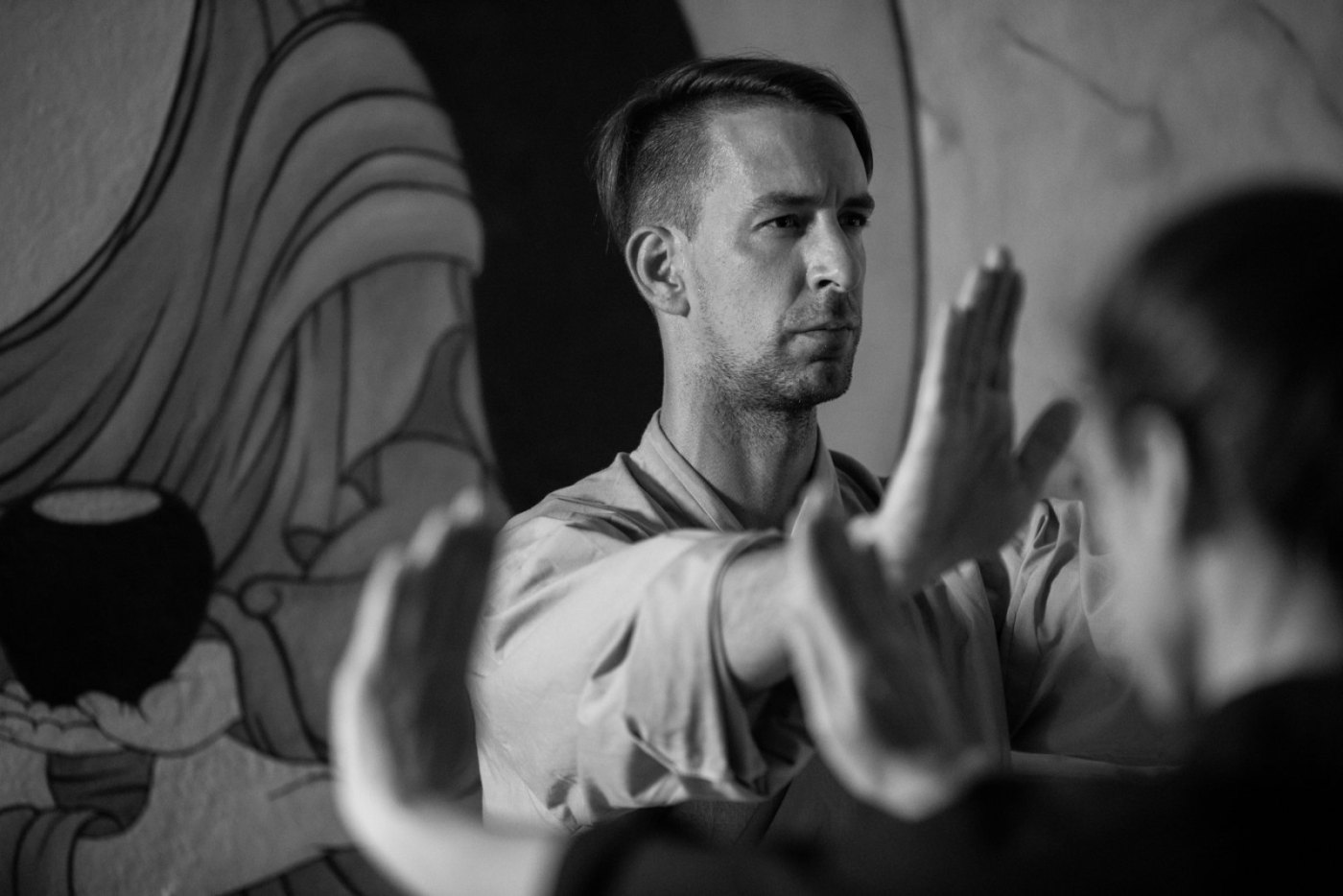
What home practice genuinely does well
It would be unfair to say it does not work. It works for three things.
Maintenance. Ten minutes of Qi Gong at home between two classes is excellent, and we explicitly recommend it to our students.
Bridging. When you are ill, travelling, or the week falls apart, home practice is what stops a missed class becoming a missed month.
Repeating the known. Once you already know a form or exercise, repeating it at home is invaluable - and that repetition is what actually produces progress.
All three share the same shape: home practice is excellent as a supplement and poor as the only source. It works when you have somewhere to draw from.
How to combine them sensibly
The sequence that works best in practice is simple. Twice a week in the hall, where you learn and where someone corrects you. Ten minutes at home in between, repeating what you learned.
The reverse - learning at home and dropping into class occasionally - does not work, because too many errors accumulate in the weeks between.
If you trained at home and stopped, that is not a verdict on your willpower. It is information: training without structure is too hard for almost everyone. That is not a reason for guilt, it is a reason to try it differently.


